
Blog · Essay
I built a habit tracker because I didn’t want to pick up my phone
Every app I found lived on the device I was trying to use less, so I opened Numbers instead and stayed there for years.
Bohdan Stefaniuk · · 3 min read
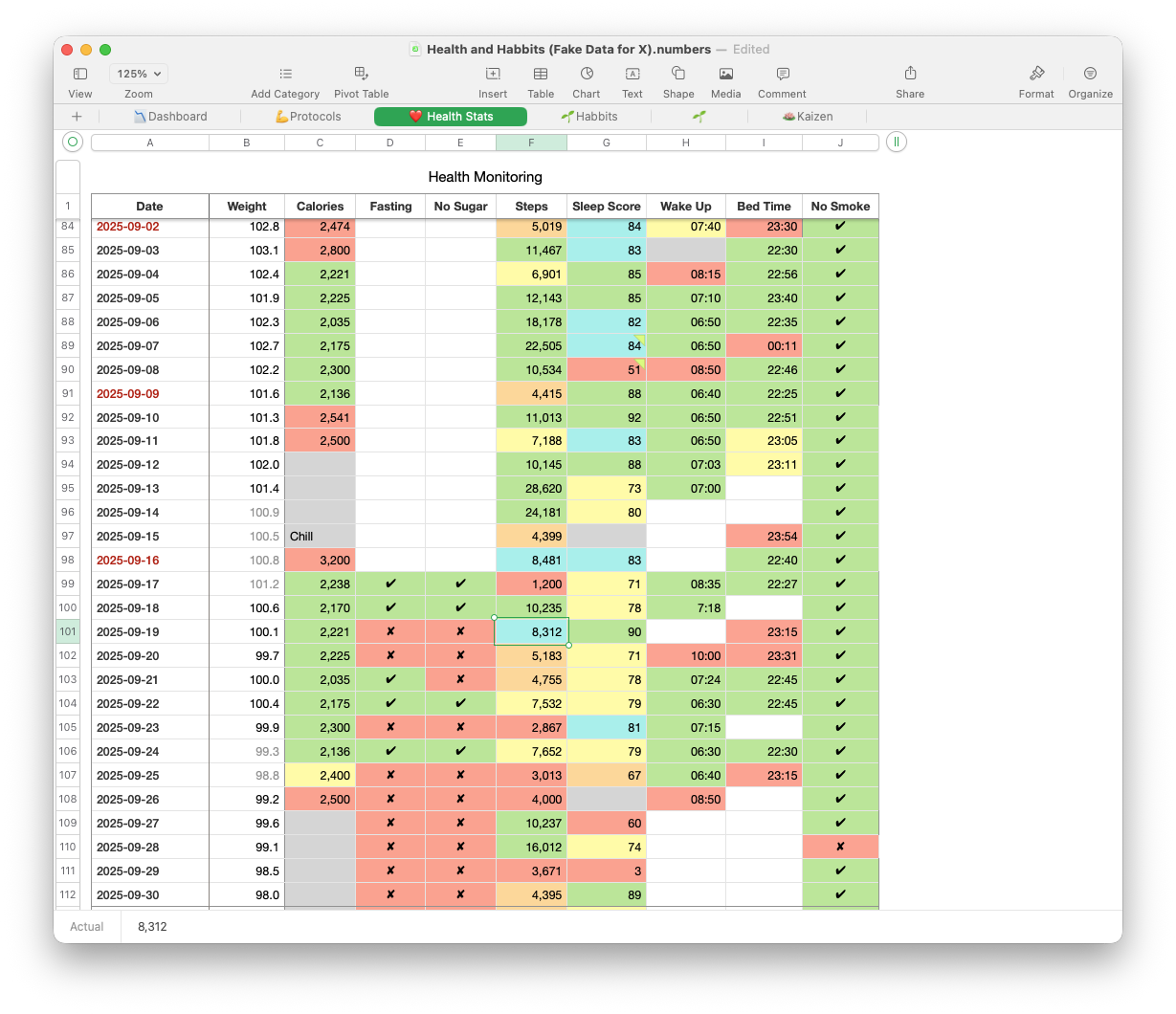
I read Can’t Hurt Me, decided to have one more go at sorting myself out, and went looking for something to track it with. There had been previous goes. None of them had lasted.
The apps were all on the phone. Nearly every tracker I tried was phone-first, a couple had a web version that felt like an afterthought, and one of the things I was actually trying to do was hold the phone less. So the routine became: put the phone down, do the thing, pick the phone back up to record that I’d done the thing.
I opened Numbers instead.
What the file looked like
Habits down one side, days across the top. Conditional formatting on every row: green for done, red for missed, gray for skipped. That was the whole first version.
The part that mattered was that a cell could hold something other than a tick. I wanted my bedtime and my wake-up time as actual clock times, and the calories I’d eaten as a number. A checkbox can’t hold 23:40. A spreadsheet cell doesn’t care what you put in it, and that is the entire case for a spreadsheet.
Why it stuck when the apps hadn’t
After a few months I noticed something I hadn’t expected. I wasn’t skipping days, and I don’t mean the habits, I mean the tracking itself. Two reasons, and neither is the one I would have guessed.
The first was bulk edit. I could open the file on a Sunday, run down four days I hadn’t filled in, and be finished inside a minute. Every app I’d used wanted one tap per habit per day, in the app, on the day it happened. Miss three days in one of those and you’re doing archaeology.
The second was that it was a canvas. When I wanted a new column I added a column. No feature request, no waiting for a release, no arguing with a settings screen that had its own opinion about what a habit is.
A checkbox can’t hold 23:40. A spreadsheet cell doesn’t care what you put in it, and that is the entire case for a spreadsheet.
What it was bad at, which I’d rather say than not
Streaks by hand. I could see the colors but I couldn’t have told you my longest run without counting cells, and I counted wrong more than once. Charts meant formula surgery every time I wanted a different view. The file didn’t sync anywhere useful, so the phone problem came straight back the moment I was away from my laptop, only inverted. And formulas break. Mine broke.
I posted the system on Reddit at some point, mostly to find out whether anyone else worked this way. Enough people asked for a copy that I put the original Numbers file and an Excel conversion on Google Drive and left the link in the thread. Both are still up.
Then I rebuilt it
The app came out of wanting the same shape without the upkeep. Same grid, same three states, same refusal to flatten a time into a tick, with the streak counting handled and the charts already drawn. The spreadsheet is still the honest starting point though, and if you want the file rather than the app, take the file.